
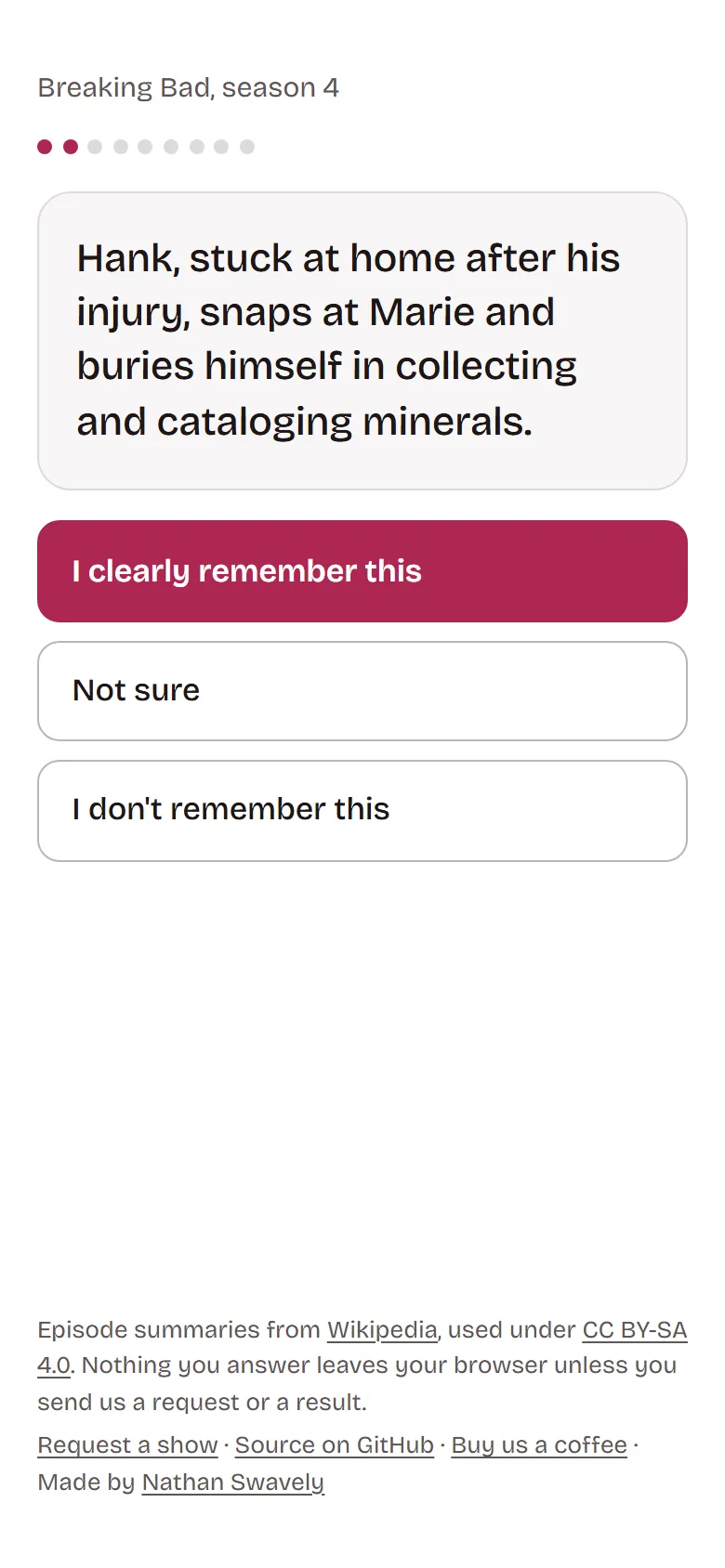

Walk forward, don't binary search
Finding one episode in thirteen is a search problem, and the textbook answer is to halve the range. Binary search opens at the midpoint, so the very first question describes a moment from several episodes past where you stopped, roughly half the time, before anything at all is known about you. The efficient algorithm spoils the show on question one.
So the walk goes forward from the start of the season instead, two or three episodes at a stride. Every card it shows is from an episode you have already seen, right up until the single card that crosses the line — and that is the episode you are about to watch anyway. Then a second pass fills in the episodes the stride skipped, one at a time, and that pass cannot spoil anything at all: every episode it asks about is either already watched or the next one up.
It costs more questions than binary search, and the bound it buys is structural rather than probabilistic. The most a walk can ever reach past your stopping point is one episode less than the stride. That is a property of the shape, not a number that came out of a test.